Ep 41: AI Threats Aren't New, Just Faster with Tyson Foods VP & Global CISO Matt Bunch




Ep 41: AI Threats Aren't New, Just Faster with Tyson Foods VP & Global CISO Matt Bunch
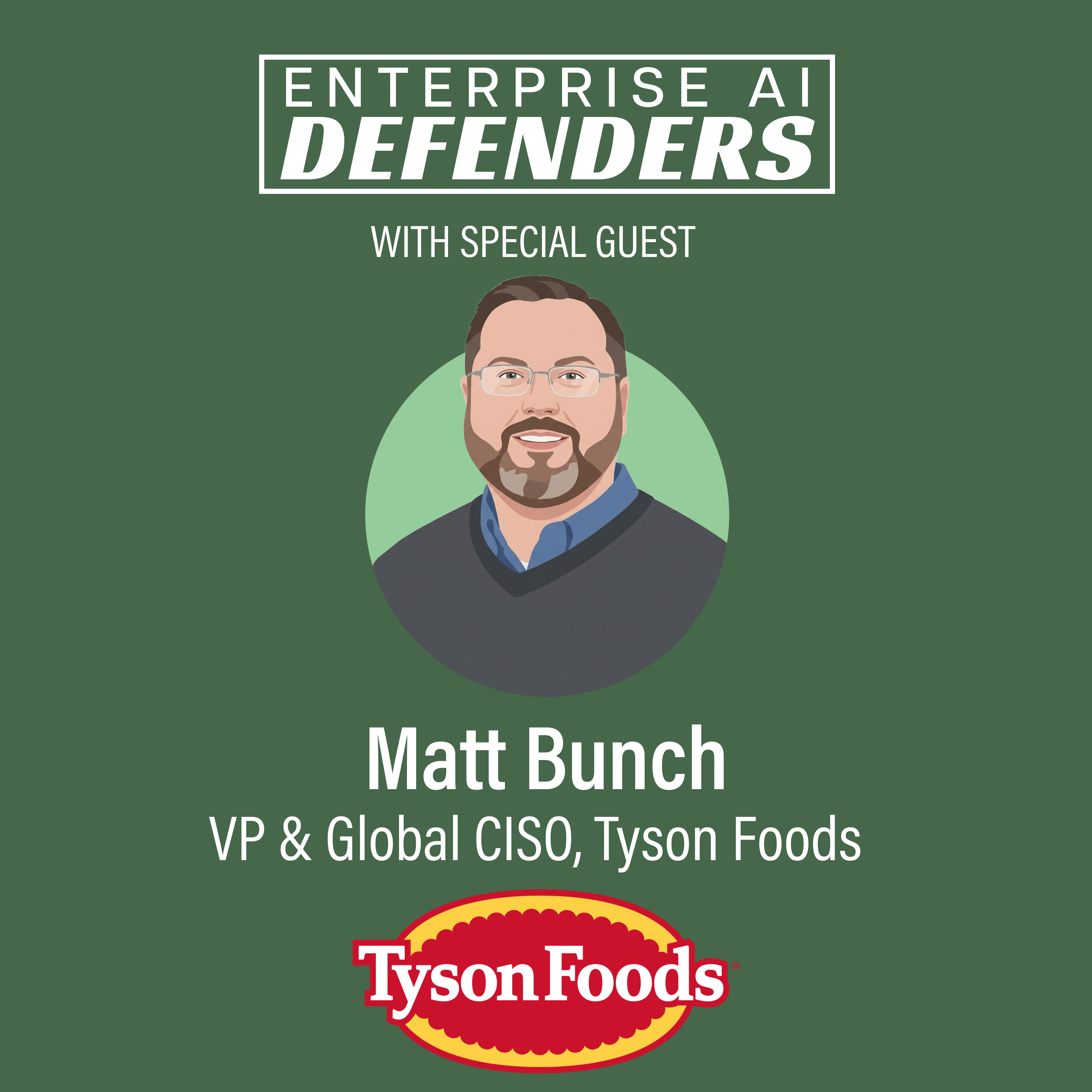
On the 41st episode of Enterprise AI Defenders, hosts Evan Reiser (CEO and co-founder, Abnormal AI) and Mike Britton (CIO, Abnormal AI) talk with Matt Bunch, VP & Global CISO at Tyson Foods, about how Tyson Foods is modernizing its security operations with AI, and why AI-speed threats make the basics more important, not less.
Quick Hits from Matt
On AI adoption across every role: "We're using the mantra 'all in on AI.' And when we say all in, it is everyone all in on AI."
On AI risk: "What is a prompt injection issue? It's a data validation issue. That's really all it is."
On agentic AI governance: "We're going to have to put guardrails in place that don't exist today to understand what the models are doing, what the agents are doing. Are they really doing what we asked them to do, or are they trying to go outside of their defined scope?"
Book Recommendation: The Art of Negotiating by Gerard I. Nierenberg.
Episode Transript
Evan Reiser: Hi there, and welcome to Enterprise AI Defenders, a show that highlights how enterprise security leaders are using innovative technologies to stop the most sophisticated cyber attacks. In each episode, Fortune 500 CISOs share how AI has changed the threat landscape, real-world examples of modern attacks, and the role AI can play in the future of cybersecurity. I'm Evan Reiser, the CEO and founder of Abnormal AI.
Mike Britton: And I'm Mike Britton, the CIO of Abnormal AI.
Evan: Today on the show, we're bringing you a conversation with Matt Bunch, VP and Global Chief Information Security Officer at Tyson Foods. Tyson is a $54 billion multinational protein company that supplies roughly 23% of all protein consumed in the United States, with over 11,000 independent farmers in their supply chain alone.
A few things stuck with me from this conversation:
First, Tyson overhauled their SOC platform this past year, migrating to next-generation AI-enabled SIEM that combines threat intelligence, vulnerability data, and live alerts into a daily digest. The result? Significantly faster mean time to detection and response, with analysts arriving at alerts with far more context than before.
Second, Matt's take on AI-specific threats like prompt injection is blunt: it's just a data validation problem, and configuration issues in AI tools are problems security has managed for years. His challenge to his team is to honestly assess whether these are net new risks, or risks the industry has quietly been accepting all along.
And finally, Matt sees security operations becoming significantly more autonomous in the next few years, but says that this future requires governance guardrails that don't yet exist. His rule is: if you trust, you've got to verify.
Evan: Well, Matt, thank you so much for joining us today. Maybe to kick us off, do you mind sharing a little bit about your background and what you’ve been doing at Tyson for the last 23 years?
Matt Bunch: Well, thanks, Evan. It’s a pleasure to be on with you today. Matt Bunch, Global CISO here at Tyson Foods. I’ve been at Tyson for almost 29 years now. I started off as an intern, so I had the great opportunity to join the organization at that level. I’ve been able to work through a lot of different infrastructure teams throughout my journey here, as well as leading integration efforts as we’ve merged, acquired, and divested companies over the years. Tyson has grown through that kind of growth into what we are today, which is a multinational, $54 billion protein company.
Mike: Matt, it’s got to be very challenging defending an organization of the size and scale of Tyson’s. What’s probably the hardest part about running security for such a large, dynamic organization like yours?
Matt: If you really think about the size and scale and scope of the operations that we run, one of the most challenging things we can think about as we defend the organization is just the depth of operations and the number of points where our supply chain is successful or could fail. There’s the diversity of business processes and operations that we need to manage across not just poultry, but beef, pork, and prepared foods. All are very different business units in how they manage their operations.
If you think about the kind of equipment they need and the team members we have to support, there are just a number of different factors. So all of those iterations really require us to think simply about how we manage our operations. I’m an engineer by trade, and keeping it simple is really one of those core practices. We try to approach that every day in how we as technology and cybersecurity professionals support our business.
Evan: I’m hoping you can share a little bit about your abilities, and the scale of your operations. You’re at $50-plus billion in revenue, which is incredible. When you get hacked, it’s not just a password reset. There’s real risk there.
The impact you have, running such a great cybersecurity program, is more than just protecting the company. It’s also protecting a lot of the customers and the entire supply chain, both up and down. Can you share a little bit about what’s at stake? Why does it matter so much?
Matt: What’s at stake for us, going back to that supply chain example, is that we are here to help sustain things that grow. And when they grow, they have a life cycle. If we do not make sure that our operations are working effectively at the right time, then we’re not going to achieve the goals that we need to.
When we think of partnering with others, we have to really think about that entire supply chain and how each component works. On the poultry side alone, over 11,000 independent farmers help us be successful. We want them to be successful. They are dependent upon us, and we’re dependent upon them.
Over 44,000 houses are involved in that across just the United States. If you think about all the fuel those locations use, all the feed and ingredients, all the corn, soybeans, all the agriculture used in those processes, think about all the protein producers and the beef farmers that are really surviving on how well their product moves to market.
At that scale, we are really impacting thousands upon thousands of lives. On the other side, we supply protein to almost 23% of the United States. That’s a core component of everybody’s meal. Making sure we’re doing it the right way, at the right quality, at the right cost structure, and at the right level of sustainability can really help us benefit everyone. There’s a huge scale involved in what we do.
Mike: Maybe you could share some examples of how AI has changed your team’s ability to triage and detect threats, and how your organization has evolved with the new technology.
Matt: We’re using the mantra “all in on AI.” And when we say all in, it is everyone all in on AI. It doesn’t matter what role you play in the organization, whether you’re a developer on our team, an incident responder, or part of our managed services solutions. You are responsible for thinking about those activities you do on a daily basis and where AI can come in and assist you.
If I think about looking at our threat landscape, plenty of organizations have daily threat reports or week-over-week reports about what’s happening in the world. What if we could take all of that intelligence coming in, marry that up with our vulnerabilities, marry that up with the actual alerts we’re seeing within a time period, and put that into a very consumable format that delivers actionable insights every single day? That takes a lot of work to get your data in the right spot. We’ve really positioned ourselves from our SOC technologies to the next generation of AI-enabled SIEM platforms.
We did a massive change to the SOC platform this past year. What we’re seeing is just much faster mean time to detection and mean time to response. Our teams are able to get to alerts much more quickly, with much more insight to work on them as quickly as possible. And then we can pass that intelligence back to our business teams and technology teams in case they need to take action.
Evan: These things you’re doing with AI today, if you had told your team 10 years ago this is what we’re going to be doing and how our jobs would be shifting, it would have felt like science fiction. But this feels very real today.
Matt: It is very real today. The real change for me, going back to where I started, is that I was one of the only developers in an infrastructure organization. I built solutions, I wrote code, as well as doing general systems administration across a number of infrastructure domains. What if I didn’t have to worry about writing the code? What if I could trust the code more reliably and really think about solutions?
Back 20 years ago, we didn’t have monitoring systems, we didn’t have some of these capabilities in place, so we had to write our own. We’re back now to a point where we don’t really have to worry about the code as much. We can go back to being solution providers and builders again and really think about how to take our organizations to the next level of automation.
That’s the real fundamental change for me and for our team, just the ability to analyze data sets and problems in a way we’d never done before. Can I take incident data from our ITSM system and put it into an AI model and say, “Hey, what are the anomalies? Let’s see what it gives us,” and then start applying additional insight? Thinking about problem management, there may be some problems that have been underlying everything we’ve been doing for a while, but they’ve never really surfaced so we could actually find a root cause. I think it’s going to open up a lot of avenues to find challenges we’ve never seen before.
Evan: It’s not just a technology shift, right? It’s also a bit of a cultural shift in terms of how IT security shows up and what they’re capable of doing. It sounds like you’ve been leading from the front to demonstrate what’s possible. If you have any pro tips for peers out there, how do you really educate and make them more aware of the things they’re able to do in this new AI world that maybe were outside their original job description?
Matt: I would say, step into an uncomfortable area. That’s one of the biggest areas of growth any of us can have: try something new. If you’re not comfortable with AI giving you an answer, test it out. Try it. Make sure you’re pressure-testing it the right way. Our own human insights take us a long way.
We’re still going to have to have that human in the loop making decisions, understanding if the answers AI systems are giving us are really the right thing. But if we’re not willing to take that chance, then you’re already stopping yourself. If you’re not willing to give the business a chance, you’re preventing it from maybe making a leap forward in some areas.
So get your hands dirty. Go run the tools. Get your own personal licenses if you need to go back to the playground. Let’s play a little bit more.
Evan: I like that. Great advice.
Mike: Along those same lines, have you run into situations with your team where some folks, maybe those who’ve been there a while, aren’t as AI-forward? How do you get them to accept the new reality of AI solutions? Do you have champions you’ve pulled out, or what’s been your experience getting everyone in the organization to that same level of experimentation you described?
Matt: We know our own time is challenged. So if there’s a tool that gives us an advantage, AI is a tool, let’s use it. Let’s get those tools in front of our team members’ hands. Now, for those who are scared or really worried about what’s to come, there’s an organizational change effort involved. As a leader, you have to step out as an example and demonstrate how AI is helping you, how it’s helping you be more productive, how it’s helping you be a better leader so you can focus more on your people.
Spend time walking around, talking to people, understanding their concerns, showing empathy, and listening to them. It’s a multi-phase approach where you have to be the example, demonstrate that you’re on board, and then provide a safe path for them to try things and make mistakes.
And then ultimately, celebrate their successes. Within my team, I’m really happy that we have a number of AI champions who are leading from the front. We want people to step up and be leaders within the organization, not just wait for me or my leadership team.
Our team has some really great leaders trying AI in a number of different situations. It may not even be AI, per se. It may just be some advanced analytics or automation. But they’re challenging the status quo, and I want them to be the example, because they’re closest to the work. They’re going to be able to show us where the true value is.
Evan: Are there new threat vectors you worry about today, or operating assumptions the community has held as true that may be less valid in the AI era? What are some things you’re worried about today that weren’t really on the radar even a year or two ago?
Matt: As AI continues to develop and our understanding of how it can be used in harmful ways grows, yes, there are going to be novel approaches where threat actors take advantage of tools, whether that be prompt injection or any other technique. There will be unique things we have to address and unique capabilities we have to implement.
As long as we stay open-minded and really push the boundaries of what’s expected and unexpected, I think we’ll continue to find those novel approaches. But if you really look at the challenges, what is a prompt injection issue? It’s a data validation issue. That’s really all it is. We’ve had data validation issues for years on applications.
If you think about configuration of AI tools, we’ve had configuration issues in all these tools for years. If you think about data issues, you’ve got access control issues. Again, we’ve had these things for years. In a lot of instances, these are not new risks that businesses have to face. But as we’ve matured our capabilities and built our security organizations, we’ve been working on each one of those domains separately to mature them.
We now have to think about it with an AI lens. You will have new metrics to think about, new threat vectors, new capabilities. But going back to the originals, we’ve had these issues from day one in all kinds of other areas. I’ve challenged my team to really focus on whether these are net new risks, or risks we’ve been accepting for a long time that nobody has really stepped up to say are acceptable or not.
So we’re really rethinking what our risk profile looks like and how comfortable we can get. If something doesn’t hit certain flags requiring a human in the loop, a regulatory requirement, a PII or PCI requirement, how much do we really care? We do care, but let’s make sure we’re judging the risk appropriately.
Mike: One area that’s been all over the news lately is newer models finding never-before-found vulnerabilities. Where do you feel you might have to adjust how you do things at Tyson, given that AI in the hands of bad actors is making social engineering more effective, finding vulnerabilities faster, and really changing the speed and pace of how fast the attacker can move? Is it changing how you approach things at Tyson?
Matt: It is. We’re really thinking about the ways that we work. How do our service desk and HR teams engage with our customers and team members when they call in? How are we thinking about identity verification? Should we employ some new mechanisms we didn’t use before? How do we think about vulnerabilities and our speed to remediation?
Many organizations have a lot of vulnerabilities. They’re drowning in them and really lack the ability to prioritize based on exploitability. There are new ways of thinking about vulnerabilities, how you’re doing your network segmentation, how you’re putting in mitigating controls that quite honestly we’re all going to have to accelerate.
The vulnerabilities are still there. The new models are going to potentially find novel ways of chaining them together that traditional humans haven’t been able to do yet. They’re going to find net new vulnerabilities we’ve never seen. But it’s how we respond, no differently than in previous incident response and business continuity work.
How do we now think about vulnerability management and patch management in that same vein, where again we focus on the highest-level risks? We understand what our security posture looks like today better than we ever have before. Think about asset management. Think about configuration management. Those core fundamental principles we just need to go back and revisit and make sure those processes are solid. Those are the areas that make and break security organizations. Too often technology teams, IT teams, and the business forget about the basics. We’ve got to go back to the basics.
Evan: Matt, when I was doing some preparation for this show, I read some of your writing about different frameworks for safe AI adoption. When a team member comes to you with new ideas for where AI can be used inside the security program, what are the first questions you ask to figure out where to invest?
One of the challenges we have at our company is that AI can do everything, and when it can do everything for a lot cheaper, you kind of want to do everything, especially when you love building things. How do you figure out where to prioritize and where the risks are?
Matt: The challenge for technology and security leaders is that we’re very excited when we see net new capabilities and we want to test things. Being an engineer, I want to get down in it and really try to understand what someone is trying to do. But I’ve got to remove myself from that a little bit and think about what the business objective is.
What is the value of doing this activity? Is it a manual process today? If so, how much time is being spent on it? How much time can we recover? What kind of data is involved? Is this something we can roll out easily, or do we need to create data for this process or improve the data quality before we can make progress?
What we turn everything back into is a business discussion. We are in the business of running our business. If we don’t think about it from a business user’s perspective, even when we’re running our own operations, then we’re missing the whole point. We can be technologists all day long. We can go home, have our labs, do all of that. But when we get into the workplace, we can bring those learnings in and apply them to real business problems.
What are the business challenges our team is having? Are we not hitting an SLA or a KPI the right way? How can we accelerate to hit those the right way? What is that business value? That’s really where I drive our team to think about those opportunities, and it’s been very helpful in helping us prioritize what’s most important.
Mike: What’s something you’ve seen on the risk landscape at Tyson that you can only see because you’ve watched it evolve over time?
Matt: I think one of the biggest changes we’ve come to appreciate is the overall complexity of supply chain and the complete dependence of our organization, and other organizations, on other suppliers, including utilities and core critical infrastructure. As we have scaled, the reliance we all have on each other has grown. That means we all need to be in it together.
It’s not just about solving our own mission and focusing on our business. What can we be doing to help raise the bar for others, in our case protein providers, ingredient suppliers, cold storage companies, transportation companies? What can we do to help influence as well as partner with them to collectively raise everybody’s security posture? That scale, that size around supply chain and how dependent we are on each other, that’s been one of the biggest lessons for me.
Mike: You’ve spoken publicly about the basics every company should get right before adopting AI, the core fundamentals like asset visibility, identity, and data governance. Where do you think most enterprises get it wrong with basic hygiene?
Matt: I think we forget that we all need to be partners rather than operating in siloed areas. I’ve heard many times that security organizations are the organization of “No.” They need to be the organization of “Yes.” They need to walk beside infrastructure teams, application teams, data teams, and business teams to find solutions. Are there lines we need to hold? Absolutely. There are guardrails we need to put in place. But if there’s an avenue to find a “Yes” and put those guardrails in place, we need to pursue that.
Our organization is no different. We’re really focusing on those partnerships, breaking down silos. Again, basic fundamental relationships. If you can understand why those silos even exist, whether it’s a political reason, somebody’s ego, or some other human element we all have to work against, and you can show how to partner as a security organization, you will start to achieve the benefits the right way.
Evan: What are some of the skills you look for in your team that are rising in value? Presumably some knowledge is going down, but things like agency and curiosity are going up. I’d love to hear how you think about what the future looks like and how that applies to shaping and architecting the team going forward.
Matt: What I really look for in a team member are some of those basic characteristics. I really value curiosity, somebody who’s willing to ask why and keep asking why until they reach a full understanding. I have a team member right now who is in a non-technical role, but she’s always asking “Why, why, why,” and she’s pushing us every day to be better in our processes and to be able to explain things more clearly. I really appreciate that from her. She’s pushing me to grow in how I can better explain things to our business and to our other teams.
Where I think we’re going to be in a year, 18 months, two years, from a security operations standpoint, is that we’re going to reach a place where we are fully trusting some of these tools to be more autonomous than they are today. But we’re going to have to back that up with good governance. We’re going to have to put guardrails in place that don’t exist today to understand what the models are doing, what the agents are doing. Are they really doing what we asked them to do, or are they trying to go outside of their defined scope?
So I think we all have a lot of learning to do about what agents can do. As we look to put some of these into production, we’re going to have to trust them to some extent. But if you trust, you’ve got to verify. We’ve got to run governance at a layer that is not obtrusive, has the right observability, the right scalability in place, so that we can focus on the next challenge.
Evan: Is there a use case or product category that hasn’t really been solved by conventional software, but that given some time and the application of AI could be totally transformed? Anything in that category for you?
Matt: I really think that given the amount of data we as technologists have, coming to a point where we can fully understand what is happening in our environment at any one time is one area that’s really going to help us in the future. That takes a lot of structure and a lot of planning.
The second is going back to that development methodology. What if we didn’t have to code anymore? What else could we be doing?
Evan: For the last five or ten minutes here, we like to do a lightning round. We give you some short questions and try to get you to respond in about a tweet’s length. These are admittedly unfair questions that are hard to answer briefly. Mike, why don’t you pick it up for us?
Mike: What advice do you have for a security leader stepping into their very first CISO job? Something they might either overestimate or underestimate about the role.
Matt: Get out of your comfort zone. Go try something new that will allow you to grow, challenge your own paradigms and your own thought processes. Go try something different you’ve never tried before. But on the other side of that, go do the things you know are successful. Reinforce those things. Continue to get better at your strengths every single day, and make sure you’re still driving those strengths in what you’re trying to deliver.
Evan: You seem to be pretty up to date on the latest technology and trends. What advice do you have for peers out there on how they can make sure they’re staying close to the frontier, especially around AI when things are changing every week or two?
Matt: The only thing we can all do is continue to learn. Go read, go read, go read. Sign up for Reddit. Listen to podcasts. Go discover something. If you don’t understand what quantum is, go open up the engineering documents behind it. When a new frontier model comes out, go spend some time playing and getting your hands dirty.
We’re going to have to go back to a mindset of continuous education. That’s the only way to stay on top of things and keep growing. Otherwise you’re going to be moving backwards every single day.
Mike: What’s a book that’s had a big impact on you and why? It doesn’t have to be cyber or even work-related.
Matt: I read a book, and it’s been years, but it was called The Art of Negotiating. That book really taught me that there’s never anything finite in either direction. You need to look for the positives in every negotiation, every relationship. If you can find commonality, you’re going to find a successful outcome.
Everybody is seeking an answer, whether you’re working on a software agreement, a contract, or trying to work through a change within an organization. The art of negotiating is really critical.
Evan: What would need to be true about the future of AI and cybersecurity that most people would consider science fiction today?
Matt: That AI is just the next thing. It’s just the next tool, the next set of techniques. What we’re going to continue to see is that we’re going to go back and revisit problems we’ve already seen. We keep thinking AI is this entirely net new thing. And while there are definite technology benefits and it is a revolutionary leap forward in many areas, we’re still just doing the same thing, but faster.
Evan: Matt, thank you so much for joining us today. Looking forward to chatting again soon.
Matt: Thanks, Evan. Thanks, Mike, for the time. Great to talk to you.
Evan: That was Matt Bunch, VP and Global Chief Information Security Officer at Tyson Foods.
Mike: I'm Mike Britton, the CIO of Abnormal AI.
Evan: And I'm Evan Reiser, founder and CEO of Abnormal AI. Thanks for listening to Enterprise AI Defenders. Please be sure to subscribe, so you never miss an episode. Learn more about how AI is transforming the enterprise from top executives at enterprisesoftware.blog
Mike: This show is produced by Abnormal Studios. See you next time!
Don't miss the next CISO on Enterprise Software Defenders
Hear their exclusive stories about technology innovations at scale.