Transforming Cancer Diagnoses and Treatment
Read about Greg's perspective on how Bristol Myers Squibb is using AI to accelerate drug discovery and patient diagnosis, including an AI model that doubled new non-small cell lung cancer diagnoses across 14 clinical sites, and an internal accelerator that gives small teams twelve weeks to prove or kill an idea.
On the 69th episode of Enterprise AI Innovators, hosts Evan Reiser (CEO and co-founder, Abnormal AI) and Saam Motamedi (General Partner, Greylock Partners) are joined by Greg Meyers, Chief Digital and Technology Officer at Bristol Myers Squibb. Meyers runs technology for a top-ten pharmaceutical company with about 30,000 employees and $45 billion in annual revenue, and his throughline is unusual for an enterprise that size: a company built to run experiments has had to learn to think like a company built to keep data.
The clearest evidence of what that shift unlocks sits closest to patients. Bristol Myers Squibb is the only pharmaceutical company with four commercially scalable AI products on the market being used by doctors. One, in oncology, reads CT scans to find non-small cell lung cancer, a disease that is hard to catch early because patients often show no symptoms. In a study across 14 clinical sites over about a year, using AI to read those scans led to a two times increase in newly diagnosed patients. It flagged roughly 2,600 patients and identified 116 new lung cancer cases. The stakes are concrete: the average lung cancer patient is given about five years to live at diagnosis, so finding tumors earlier changes what treatment can do.
Getting there forced a change in self-image. Bristol Myers Squibb had always thought of itself as a science company, where the goal is to run an experiment and the data is the byproduct. To a model, Meyers explains, "negative results matter as much as positive results." He describes the work as a game of "connect the dots," where the more dots on the page, the better the drawing. An experimentally focused culture records its successes and discards its failures, which is exactly the data a model needs. So the company had to rethink how it stores, annotates, and curates data, treating it less as exhaust from an experiment and more as a resource to mine later.
The path was not clean. In the first year, going back about three years, the company let "a thousand flowers bloom," and it did not work. Everyone built a tool for their own part of the process, and nothing connected. Meyers and the peers who run the company switched to a top-down approach, sitting down function by function, across research and development, commercial, HR, and finance, and asking where AI could make the biggest difference. In drug development, that resolved into three anchoring questions: can we accelerate trials, lower their cost, and increase the probability they succeed. Those anchors became a natural filter for which ideas were worth pursuing.
To pursue them without betting the company, Bristol Myers Squibb built what Meyers calls the AI accelerator. Six to eight engineers get a common set of tools and a time-compressed schedule: two-week sprints and twelve weeks to prove or kill a single hypothesis. The design is deliberate. In a highly regulated industry the cost of failure is high, so the work cannot happen in a Big Bang. Keeping teams "too small to fail" in any public or embarrassing way gives them room to throw away the work and start over, and the pressure of presenting every two weeks keeps them on the core question: “can it do this or not,” instead of building interfaces and debating what to name the thing.
For all the talk of models, Meyers is firm that the binding constraint is human. "Psychology and sociology trump technology every time," he says, citing Charlie Munger: show me the incentives and I'll show you the outcome. It is why he is more bearish than Sam Altman or Dario Amodei on how fast AI will change the world, not because of the technology, but because people's willingness to adopt it takes longer than expected. The job, as he frames it, is having the right conversations about what is now possible and building the enrollment that turns that into reality.
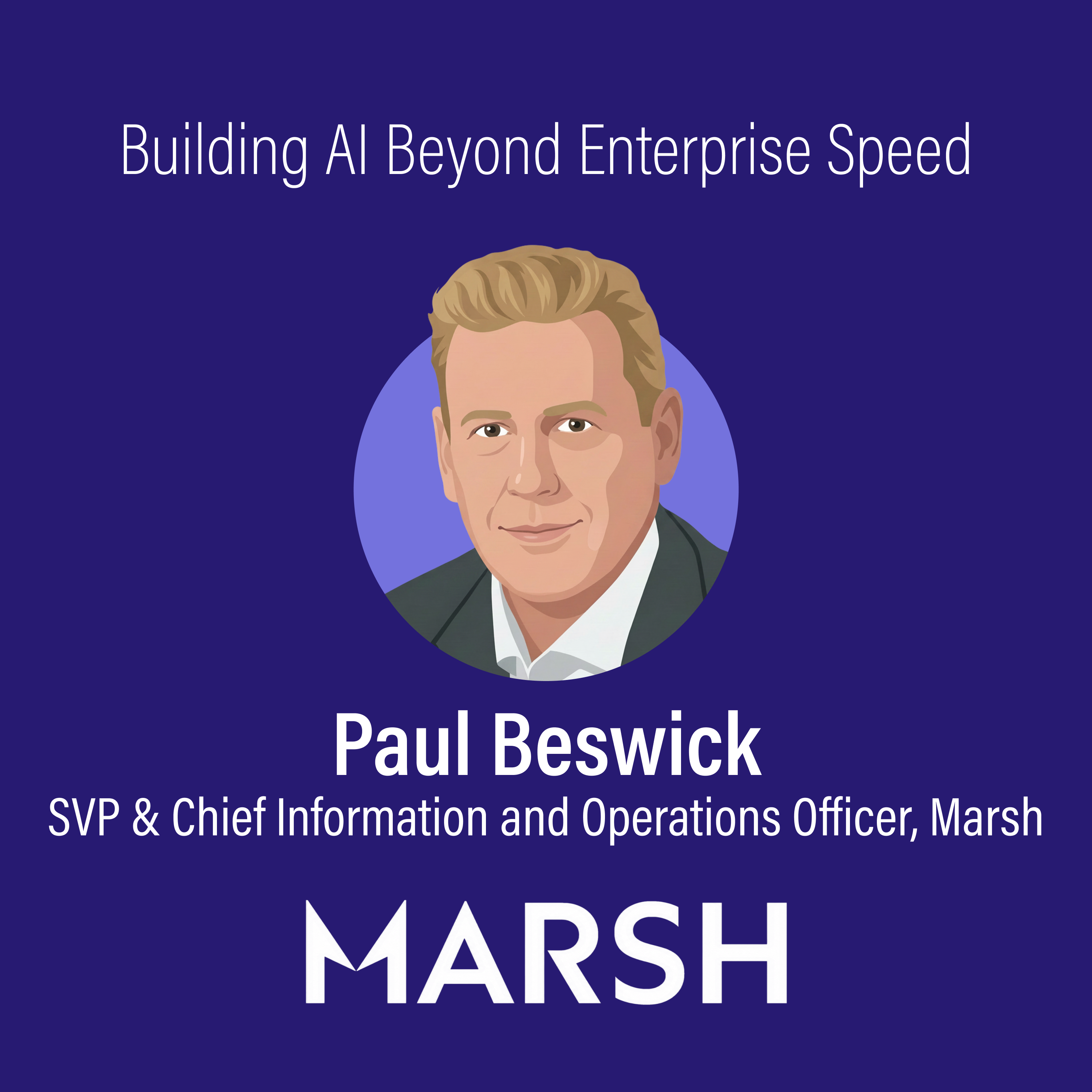
AI Beyond Enterprise Speed
Read about Paul's perspective on how Marsh is using AI to rebuild internal knowledge work and client-facing products, including a voice-based crowdsourcing pilot that turns scattered expert opinion into a scalable artifact, and a home-built productivity stack that trails the commercial market by only a few months at a fraction of the cost.

From Copilot to Colleague: AI at Thomson Reuters
Read about Joel's perspective on how Thomson Reuters is using AI to reshape knowledge work, including agents that take W-2s and 1099s and produce a completed tax return, an AI-first engineering organization where the engineer's job has shifted from contributor to controller of the codebase, and the two trust gaps that still hold enterprise agent adoption back.