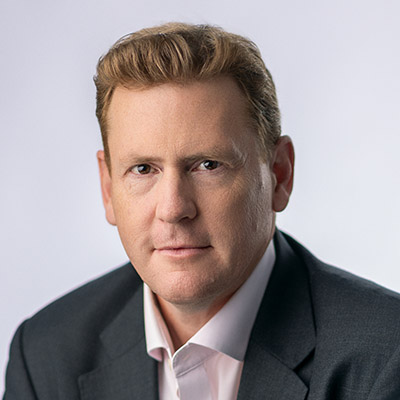
On the 68th episode of Enterprise AI Innovators, host Saam Motamedi (General Partner, Greylock Partners) is joined by Paul Beswick, SVP & Chief Information and Operations Officer at Marsh, for a conversation about what is happening to the cost of building software at a global B2B professional services firm. Paul's argument is straightforward: the cost of building a production-grade AI tool has fallen so far that the cost of the meeting to debate the build is now often higher, and the months of budget negotiation that precede the meeting are higher still. Marsh's response has been a portfolio of small, internal tools rather than a flagship program.
One of those tools is a voice-based crowdsourcing pilot running across several teams. Instead of asking people to fill in a survey, type a long email, or attend a meeting, the firm puts a question in front of them and asks them to dictate two or three minutes of thinking into a central form. AI cleans up the dictation and processes it into something the firm can act on. The monthly version has a client team answering the same prompts every four weeks about what is happening with a client, what issues are surfacing, and what needs to travel upstream. The event-driven version pings the firm's specialists for two or three minutes of expert opinion when something like the Strait of Hormuz being blocked changes what clients need to know. The combination becomes "an asset that actually can scale," not expert opinion sitting in someone's inbox.
That instinct came out of Marsh's earlier bet on LenAI, the firm's internal general-purpose AI tool. The first version was created in late spring 2023, weeks after Microsoft unlocked OpenAI model access for the firm. It went to a pilot group of a few hundred people by the start of summer and to the entire firm by the end of it. Because the team was building so early, they had to build pieces the market had not yet standardized: tool routing before MCP, multi-step planning before agent harnesses. Those pieces have since been swapped out as standards arrived. What remains is the connector layer LenAI grew over time: document processing, translation, summarization, office-suite plumbing, and data connectors of various kinds. That is the scaffolding the firm now uses for industrialized AI work in the operations organization, whether LenAI itself continues to exist or not.
AI's biggest contribution at a firm like Marsh, he argues, is the accumulation of hundreds or thousands of small things people figure out across different jobs to make themselves more effective, which is much harder to put on a board slide than a $100 million problem. His evidence is a handful of unromantic examples. The firm's home-built agentic AI tool, in pilot now and rolling out soon, lags the commercial market by a few months and costs a fraction of the alternative. LenX, a browser extension built on top of LenAI, reads values out of one application's page and offers a one-click paste into the next, which makes data entry meaningfully faster and more accurate. Two days before recording, Paul used Claude Cowork to build a local HTML file that turns a recurring spreadsheet into a desktop dashboard. None of these fit neatly into a year-end deck. Together, they redefine the day.
All of which forces a question Paul thinks most CIOs are answering wrong: how do you fund work that is this cheap to build and this hard to pin to a single P&L line? At Marsh, LenAI happened before the conversation about whether to build it did. It was put together over a weekend and went into pilot. "There was zero cost to doing that," Paul says. The only live question was whether the firm would like how the cost grew with use, and the cost moved in step with use and value. He cites a LinkedIn observation that the cost of the meeting to debate a build is now greater than the build itself, with months of budget negotiation costing more still. The way money flows for software has to change, and the way the tech function is organized against the business has to change with it.
The principle Paul keeps returning to is the unit of work. If a new CIO asked him for three AI projects to run in year one, he’d refuse the premise. Three implies they’re big, and big projects, in his words, are "designed to fail." His advice is to take the three and break each into twenty smaller builds, then run them sequentially. Those sixty small projects will accumulate the momentum and signal that one ambitious program will not. The right answer is not the right project. It is the right cadence.