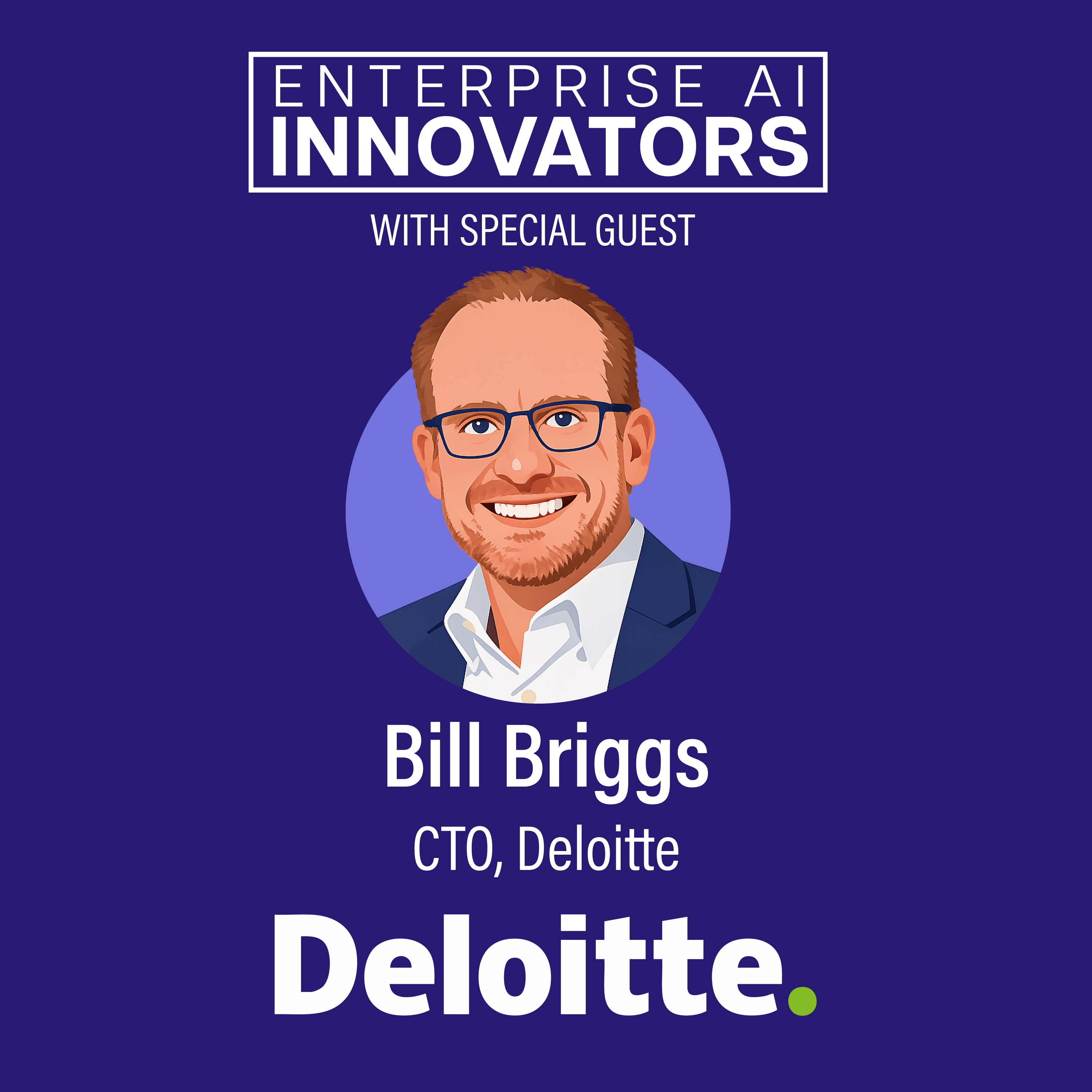
Ep 64: Outcome-First AI Workflows with Deloitte CTO Bill Briggs
On the 64th episode of Enterprise AI Innovators, Bill Briggs, CTO at Deloitte, joins the show to share how leaders can move from “AI demos” to durable workflow change, starting with CEO-level conviction, modernizing the systems that agents actually need, and embedding trust and security into the engineering pipeline.
On the 64th episode of Enterprise AI Innovators, host Saam Motamedi (Greylock Partners) talks with Bill Briggs, Chief Technology Officer at Deloitte. Bill argues that most organizations stall because they try to graft new models onto old workflows, and because their data and system foundations were never built for agentic execution. He shares a practical “start at the outcome” framing, why modernization still matters (even in the GenAI era), and how trust, security, and privacy have to be engineered in, not audited after the fact.
Quick hits from Bill:
On AI-native starting at the top: “I actually start with the CEO and the chair and sit them down and say, if this isn't coming from you and this not this isn't about here in a year, it's about here. And what that means. We should stop the conversation…”
On why agent pilots stall without foundations: “[Leaders hoped GenAI meant] we didn’t have to do… hard work in data foundations… [but enterprises lack] orchestration backbone… microservice enablement… without that, the bounds of what agents can do [are] limited.”
On redesigning outcomes, not steps: “The point is, you want to have folded clean laundry when you need it. Not [a] step by step replacement of the steps you learned as a child to complete that task.”
Recent Book Recommendation: Unreasonable Hospitality by Will Guidara
Episode Transcript
Evan Reiser: Hi there, and welcome to Enterprise AI Innovators, a show where top technology executives share how AI is transforming the enterprise. In each episode, guests uncover the real-world applications of AI for improving products and optimizing operations to redefine the customer experience. I’m Evan Reiser, the founder and CEO of Abnormal AI.
Saam Motamedi: And I’m Saam Motamedi, a general partner at Greylock Partners.
Evan: Today, Saam is talking with Bill Briggs, Chief Technology Officer at Deloitte. Deloitte is an over $30 billion powerhouse with half a million employees across 150 countries. As CTO, Bill spends his time advising government agencies and Fortune 500 giants. He’s got a vantage point on AI adoption that very few people on the planet can match. Here are a few things that really stuck with me from their conversation.
First, Bill used an example of a recent laundry-folding robot demo to level-set expectations about AI. People mocked it for being slow, but he says they’re missing the point. You don’t need a robot to act like a human. You just need folded laundry. We have to stop trying to replicate individual steps and start reimagining the entire outcome.
Second, there’s a massive disconnect between the C-suite and the front line. Deloitte’s data shows that while over 70% of executives are hyped about AI, that number crashes to just 6.7% for frontline workers. Bill argues those employees are actually the ones who know where the real problems are.
Finally, a lot of leaders are waiting for the next model or more certainty. Bill’s take: that’s a great way to let your competitors run you out of town. He tells CEOs up front: if this isn’t a top-down mission to rethink your entire business, don’t even bother starting.
Saam: Bill, thanks for joining us today. I’ve been really excited to have you on. And maybe just to start, you and I were talking before the show got started—you’ve been at Deloitte now for several decades. Maybe just start by giving us an overview of you and your career and what you currently do at Deloitte.
Bill Briggs: Yeah, it’s great to be here. Big fan of the show, and thanks for the warm invite.
So, Bill Briggs—I’m Deloitte’s Chief Technology Officer. And it has been… it’s nice to say a couple decades. It’s actually been 28 years. Computer engineer that came out in the ’90s, and thought my path would take me to your backyard and be in industry and be a part of the wave. I did a software engineering internship with the leading telco at the time—I won’t name names—but realized quickly that I didn’t quite have that… at that time in big tech, the wave of workstations shutting down at 4:45 so that everyone could make sure and beat traffic on the commute home didn’t inspire me.
And at the time, Deloitte in professional services wasn’t even on my radar. But the timing was perfect. As you know, we’re a 180-year firm now. At the time, a 150-year-old firm was moving from tax and audit being the main business to this little thing that was consulting—and within consulting, a glimpse of technology might matter, might be an interesting thing to have on the balance sheet.
So I, as a deep technologist coming in with kind of founder’s energy as a 22-year-old, got to lean in on the biggest, nastiest projects that we got to do, unleashing tech cross-industry. And that was contagious.
And I kind of said at the beginning, as soon as I stop having fun, I’m going to stop doing it. And it was there front and center to see the rise in cloud, the rise in SaaS, the rise in AI, now the rise in quantum and physical AI and robotics. And I actually created the CTO role at Deloitte because we didn’t have a function incubating emerging tech, trying to develop the tech agenda for our clients and help them look forward.
So it’s been a great ride. I spent a lot of time in-market advising our clients—public and private sector—about what all this means and what they should do. I think my superpower is to take it from the what, to the so what, to the now what. That computer engineering degree—with an MBA at Kellogg along the way—is a nice one-two punch.
From boardroom to server room, I still code. My own lab is the envy of some of the team. So it’s that mix of credibility. We’re not just chasing headlines and rhetoric. It’s like: let’s roll up sleeves, make it real—and for our clients, let’s make it real at scale.
Saam: You touched on the expansion from accounting and tax to consulting. I don’t know if all of our listeners fully appreciate Deloitte’s true scale and sheer size and scope. So how would you summarize what Deloitte does and what the scope of it is?
Bill: The headline is: $30 billion-plus entity, in 150 countries, with half a million people. This is massive—and centuries old, almost.
The awesome thing is seeing our outcome—what we drive for our clients’ outcomes—and how we do that has evolved. In this moment in time, it’s being able to look anyone in the eye, including the International Olympic Committee. Like, we’re running the Olympic Games in Milan right now. Deloitte is the tech provider of the underlying ops—everything you see being broadcast on media, the fan data platform that’s there. So the scale of being able to say something like that makes me proud.
But our business is evolving because tech is at the heart of business. Tech is at the heart of strategy. And we want to help get value and outcomes faster. So how do we codify the knowledge we have in deep industry, deep functional domains, and bring it to life in products and platforms and agents—and do that venturing with alliance and ecosystem partners, big and small.
It’s really this story of a firm that’s been around since the advent of electricity and automobile and commercial air travel and space and everything we know about computer science. We’ve pivoted over the years. In this moment in time, it’s: how do we harness AI and tech into reimagining business and business models and industry. And a big piece of it is our own transformation.
Saam: Before we start to talk about the transformation at Deloitte, let’s talk about the external-facing side. If you took a Fortune 500 client today that came to you and said, “Hey Bill, we want to become AI native,” where would you start? What pillar would be most critical to start with, and what would you go do?
Bill: I’d start with the CEO and the chair. I’d sit them down and say: if this isn’t coming from you—and this isn’t about here and here, it’s about here and what that means—we should stop the conversation. Because it’s so easy to say that, and what we mean is incrementally drive some efficiency gains with a commitment to the Street to have some kind of SG&A saving. And that’s not interesting. I’ve yet to find any client that can shrink themselves to success and growth.
So then it’s… and this word gets thrown around a lot, but the idea of reimagining your business. Because so much of technology assumed the human workflow, and the way it started and got digitized and replaced is still the anchor point.
And the analogy I used with the life sciences CFO and their team a couple days ago—I was at CES, Deloitte kicked off the research track, and I was pointing to the laundry-folding robot from the electronics manufacturer not to be named. And the commentary from a lot of folks was, “Wow, it’s so slow. I would never… my teenager can do it faster than that.” The point is: you want folded, clean laundry when you need it. Not step-by-step replacement of the steps you learned as a child to complete that task.
And we’re still in the early days of trying to retrofit physical AI and robotics on top of a world built for an assumption of human-based participation. It plays into unloading the dishwasher. That’s such an unnatural form for robotic cleansing of plateware—to assume it has to go into a rack, to come out into a shelf. We’ll see kitchens…
And it’s funny how much that unlocks the: “Oh yeah—if we’re just thinking about invoice management automation and how do our financial analysts do ledger consolidation faster…” Some of the things the CFO typically starts to think about with AI—the ceiling’s pretty low.
But we say, “Hey, let’s identify: how do we think about working capital management, and what are all the pieces that would have to go into it that would give your people the ability to make different decisions on procurement and pricing and deployment of capital?” That’s a completely different mindset. And you might say: a lot of the things we thought we had to do, we might not even have to do—or certainly we wouldn’t do them the same way.
Saam: You get to see lots of AI use cases across all of your clients. Are there any common patterns—concrete areas where you see people start and get a quick win? Or maybe an interesting use case you’ve seen that others should consider?
Bill: Part of it is: the closer you get to where the work’s actually getting done, the faster the better.
We have a broad study about trust in AI, and the difference between the ivory-tower C-suite—70-plus percent bullish, trusting, optimistic worldview—when you get to the front line, it’s 6.7%. And those are the individuals that typically know exactly where knucklehead lives. Like: “Oh, we’ve been imagining these constraints of steps are necessary,” and pain.
That could be in a hospital system doing claims pre-processing and pre-approval, which is a great example. If you really break that down into what the outcomes are, work backwards: a lot of the process isn’t regulatory-driven. It’s just institutional inertia. We’ve always… and it’s complicated because a lot of players. But you break it down: nobody wins the way it’s being done now.
So the one-two punch is bounded enough to get out of this dangling-modifier hyperbole of, “We’re going to tackle revenue cycle management in a hospital system and insurance lifecycle,” to: “We want to get to pre-auth approvals faster, better for patients, cut down administration tasks, less handoffs, real operational costs.” And innovation is better with company.
So how do you bring the ecosystem together as quickly as you can to fundamentally… I like to say: trailblaze, not guinea pig. But then one of my clients gave me a nice little t-shirt with a guinea pig on fire—which I thought was… I should be wearing that right now, because that’s what it feels like sometimes.
But the other thing is: in this moment in time, what I hate—especially at the C-suite—is this feeling of paralysis because, “Oh, we need to wait until the next round of foundation models are released,” or “We need to wait until we’ve got complete certainty on how all the puzzle pieces are going to come together.” That is a recipe to watch others eat your lunch or put you out of business.
Saam: I still see this expectation gap in enterprises where they love the demos, but then they can’t point to things in their environments that have really hit scale—especially around agentic. Why do you think that is? What’s the technical hurdle stopping people from getting out of pilot into agents in production?
Bill: Part of it is there was a genuine hope that—three years ago with GenAI, now with agents—we didn’t have to do some of the hard work in data foundations.
Think about a lot of our clients—the largest Fortune 500, largest government agencies—that haven’t invested. It’s not like they’re there with an orchestration backbone, with microservice enablement of all their core capabilities, ready to participate in an agent or multi-agent orchestrator reimagined process. It’s been bubble-gummed together over the years. The spend hasn’t been what it needs to be. The CIO has raised the issue, and they’ve been told: “No, come on—we’re not looking to spend our precious capital on core modernization readiness. Do your job better.”
So suddenly: this idea of… we can identify. But without that, the bounds of what the agents can actually do is limited—and for good reason. Enterprises have a different control plane than you or I playing with OpenAI at home. You see the unbounded leads to breakthroughs in ways we didn’t anticipate, and the flip side is: we haven’t put the rails in place in big enterprise to participate in broader agentic, multi-agent.
So it needs to be a surgical response. It’s not: “Go modernize every single bit of your code base before you can take advantage.” A bit of this is: how do you know where to focus, what really matters?
And then good news: we can apply AI to get sense of the data mass. We can apply AI to refactor and modernize your core systems. That’s the hero’s journey—but it still has to happen. And I’ve been in a few boardrooms where that gets an “Amen, hallelujah,” from the tech executive that’s been trying to make that point for years.
Saam: I hear a lot of leaders ask, “How do I get my workforce to understand what’s possible?” How does Scout work? What have you learned about empowering your employee base with AI from that?
Bill: Conversations don’t always repeat, but they rhyme.
Part of it was having a skill matrix and a capability matrix that we could use—keep constant, keep relevant—and baseline to say: okay, where can we get second- and third-party content providers and training and learning to complement the things we’re investing in ourselves, and have that as a common backbone.
There’s a huge piece of it saying: how do we put in place… as sexy as it sounds to say “the ontology of skills in a modern tech landscape” just rolls off the tongue, doesn’t it? But that was an important piece.
And then the humility of: I don’t want to be in the business of creating deep content on every vendor slice for certification and skill development. We want to decide the places we should invest and own—which there’s many. We still have in-person experiences and all the things you’d expect, complemented with the best we can find in market that we bring in—tailored: “Here’s what would be interesting to you,” or “Here’s what you need to progress to the next.”
And then the last piece—which has been a long effort, but it’s taking hold—is our broader talent model. It was based on tax professionals and auditors and consulting partners in the career progression. Very different when you’re talking about engineering personas. In my teams, we’re hiring PhDs in physics and material science to lead the quantum business. That old model doesn’t make… how you’re measuring performance, how you’re incenting growth, the titles you’re giving people to bring to the market.
Saam: How do you think about AI’s impact on cyber? Are there specific AI capabilities that scare you from a cyber perspective? And are there things that excite you from a defense perspective?
Bill: Typically, when I’m doing a broader C-suite board, I break down the world into elevating forces—advances in computation; advances in information and models and agents; advances in interaction and physical manifestation of technology. That’s the hero’s journey.
The three on the bottom—we hit two already—but just to play it out: core modernization, which we hit on—the amen from the tech executive—and how that’s changing investment portfolio, the way you have to deliver the role of the tech leader. We sprinkled that in.
And then trust: security, privacy, regulatory, compliance, sovereignty—you get the idea—and ethics, morality. Because it becomes a part of your brand: how you’re thinking about and how you’re living those values.
With security, one thing we know—it’s what we do at Deloitte, and what my clients are doing as well—if you make it a compliance-based series of events applied after the fact, separate from your core pipeline and engineering lifecycle, you’re already close to dead in the water. You’ve got to embed it. Guardrails, the right policies—it’s embedded in the environments being instantiated. It’s embedded in the pipelines and data flows. It’s embedded in the testing automation. It’s embedded in deployment.
Saam: What are the AI use cases you haven’t deployed today, but that you think you’ll deploy over the next couple of years that you’re most excited about? And are there things you hear your peers talking about that you’re more skeptical of?
Bill: Whenever the conversation anchors on GenAI—and it’s not dismissing any of the platforms and providers—it just feels like we’re relegating a really mature conversation into parlor tricks.
Part of it is too many clients still have a consumer-based chat window as their mindset of utility, or their favorite personal assistant on their desk, and saying: “Why don’t we do that?” And unfortunately, I do think some industry rhetoric—and even some of the research that gets a lot of attention about the lack of value—when you read the detail behind it, you can see even the way questions are being framed. It’s good we talk about it. It’s doing its job, I guess, for headline and clickbait.
But the thing that does not fall in that category is the continued advance in physical AI and physical robotics. The endgame of humanoid, multipurpose, multifunctional is exciting, but in an abstract way. What we’re seeing real investment in is on hospital floors for material movement; in factory floors for more dynamic parts of the assembly line; in remote inspection.
We have two clients on different coasts that we’ve helped with drone-based, AI-driven inspection of power lines, and the ability to basically give… the humans are still out doing the final call about what needs to be cut and trimmed and what work has to be done. But we looked at every literal line, every literal tree, every literal leaf on every literal branch, and applied very sophisticated weather models to be able to say: “Here are the places where, instead of having them go out and canvass the entire operating range and hopefully stumble upon the few that will make a difference and stop outages or wildfires…”
And flipping that—it becomes superhuman in a way. And I think we’re in an unfortunate cycle because of investment and it makes for sexy selfies and headlines that the endgame form factors in robotics get so much attention.
Why does it matter? If we went back to the AI discussion and moved from broad, empty potential into very targeted—when you’re talking about: “I want to move a pallet off the loading dock,” or “I want to bring a lab kit to an operating room.” You can’t get more tangible than that. And almost every one of those examples is doing material work improvement that’s being not just accepted, but welcomed by their human counterparts as a member of the team.
Saam: We like to end every show with a lightning round—your one-tweet answer. Sorry, some of these might be a little challenging to get into one tweet, but I’m sure you’ll be able to.
If there were only three AI transformation projects you could do as a new CIO that you’ve got to get done in your first year to be successful—you start a job as a new CIO or CTO tomorrow—what would those projects be?
Bill: I would do all three—three rounds of optimization of my engineering capability to get the… it’s almost like a genie wishing for more wishes, but I’d say invest in your own throughput and output.
And then, okay, maybe two of those. And then whatever the pet project of the venture lead or the CEO is—the other one—just to show that you care.
Saam: Those are both good. The first in particular—if you make the underlying engine faster, everything else is downstream of that.
What is the best way CTOs today can stay current on what’s happening in AI? There’s so much information—how do you stay current?
Bill: It’s not a spectator sport. You have to roll up sleeves. I teased before—this is just the office—but I have a house full of gadgets and workshop space. There’s no substitute.
And it doesn’t mean you’re the… God forbid, if I was the leading expert at Deloitte on any topic anymore. But to be hands-on enough to have the sniff test of what’s real, what’s not, and to be able to give teams some intelligence steer—and then be very gracious in saying: “Teach me, because I don’t know.”
The best podcasts in the world can inspire you where to go and lean in, but there’s no substitute for leaning in.
Saam: What’s a good book you’ve read recently that’s had a big impact on you, and why?
Bill: I just finished last night Unreasonable Hospitality by Will Guidara, who’s the Eleven Madison Park… and it was a compliment that someone was like, “This reminds me of your leadership style.” And I’m not saying that for cheap. It’s one of the best compliments I got in a while.
As I read through—I knew a little bit of the story, but I didn’t know all of it—the ruthless emphasis on making your people feel empowered to bring your vision to life, and then willing to kind of blow up all rules about what it means to make that real. It’s a hell of a one-two punch.
My other: I read Infinite Jest every year—David Foster Wallace is my favorite author. I know a lot of people have it on a bookshelf, but it’s something that’s more on the fun side.
Saam: Those are both good ones. As a side note, every winter I gift a book to all the CEOs I work with, and two years ago I gifted Unreasonable Hospitality. I think it is an exceptional book. A lot of our portfolio companies like to say they’re customer-obsessed, and then I ask them to read that book and come back and tell me if you still view yourself as customer-obsessed.
Okay, maybe one last one: What do you believe about AI’s future impact on the world that most people listening would consider science fiction today?
Bill: On a personal note, we’ve had some mental health issues with my immediate family, and I still think we’re barbaric in how we even talk about—much less treat.
So the unlock in personalized medicine—for good reason, most of the time we focus on oncology, which is amazing—but the idea that we’ll finally unlock the inner workings of the trillions of synapses to be able to, one, build empathy into the system—which is still lacking—but then more importantly, treatment paths.
I think that’s something in our lifetime we will see incredible progress on, and I would argue long overdue.
Saam: I completely agree. I think that is one of the many things I’m very optimistic about that we’re going to see with these new models and systems.
Bill: The flip side is we’re seeing all kinds of additional mental health disturbances because of… so that’s real too. But big picture, long term, I hope for goodness out of it.
Saam: I like to tell my colleagues and my family: it’s better to be an optimist—life is more fun as an optimist than a pessimist. So I agree with you on both sides of the coin, but I also take the optimistic view.
Bill, this has been awesome. I seriously could have kept going for a couple hours, and I do want to do an encore to this. But really appreciate you taking the time and joining us on the show today.
Bill: Yeah. And I think just a message to everyone: no matter how much traffic there is, the sooner you leave, the sooner you get there.
So if anyone is still having a wait-and-see approach on it—I don’t know, inspiration doesn’t do as much as desperation—but let’s try to end with a little dose of inspiration. Because I would argue desperation is probably coming. But anyways, always a pleasure, man. It’s great.
Saam: It’s great. No time up. Thanks, Bill.
Evan: That was Bill Briggs, Chief Technology Officer at Deloitte.
Saam: Thanks for listening to Enterprise AI Innovators. I’m Saam Motamedi, the general partner at Greylock Partners.
Evan: And I’m Evan Reiser, the founder and CEO of Abnormal AI. Please be sure to subscribe so you never miss an episode. Learn more about enterprise AI transformation at the Enterprise Software blog. The show is produced by Abnormal Studios. See you next time.