Ep 65: Bold, Fast, Responsible Workflows with KPMG International Global Head of AI & Digital Innovation and KPMG US Vice Chair, AI & Digital Innovation Steve Chase



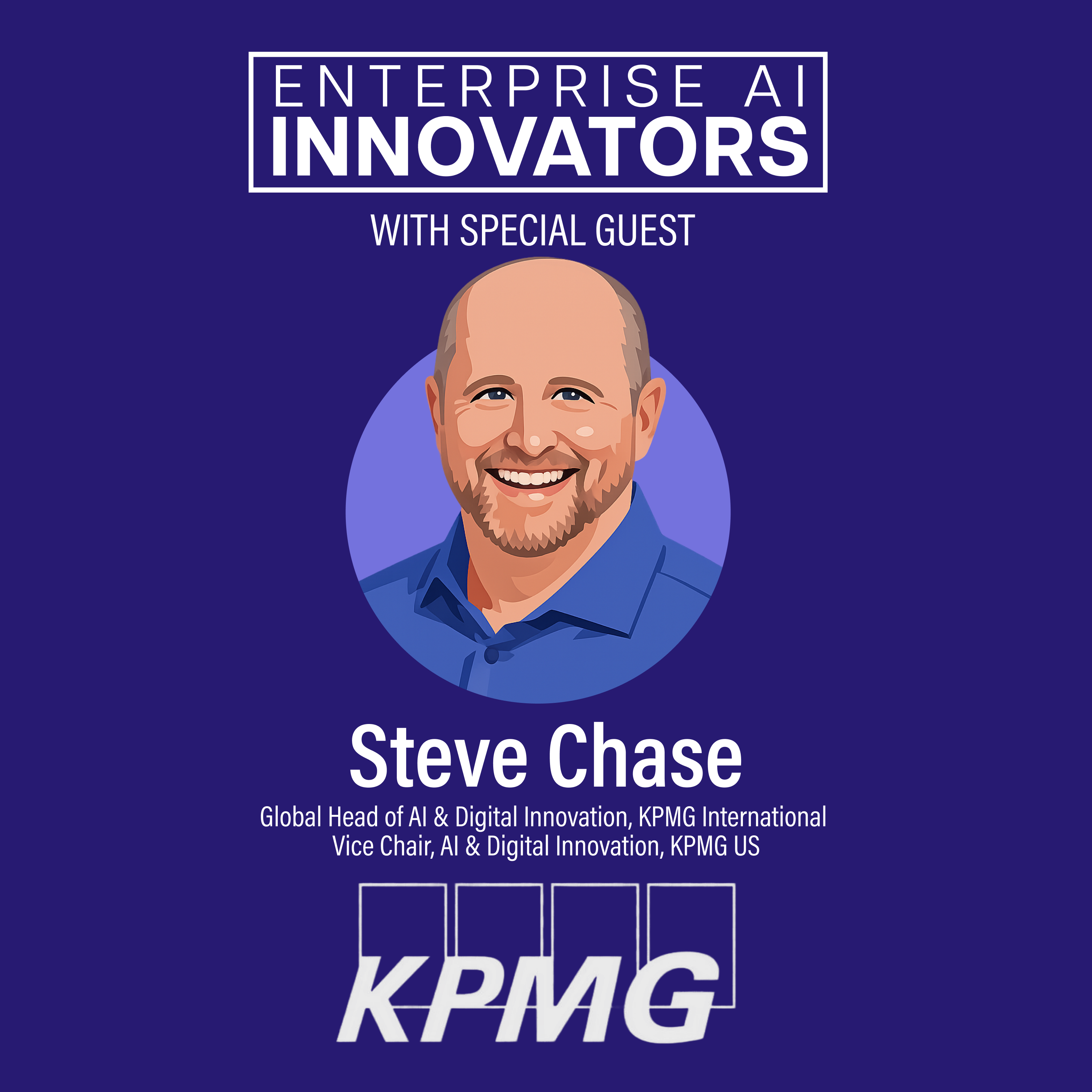
Ep 65: Bold, Fast, Responsible Workflows with KPMG International Global Head of AI & Digital Innovation and KPMG US Vice Chair, AI & Digital Innovation Steve Chase
On the 65th episode of Enterprise AI Innovators, Steve Chase, KPMG International Global Head of AI & Digital Innovation and KPMG US Vice Chair, AI & Digital Innovation, joins today to explain how the firm drives AI adoption across 250,000+ people, starting with enterprise search and moving into agentic workflows. He shares governance moves that made “bold, fast, responsible” real, plus what he’d prioritize in year one as first Chief AI Officer.
On the 65th episode of Enterprise AI Innovators, hosts Evan Reiser (CEO and co-founder, Abnormal AI) and Saam Motamedi (General Partner, Greylock Partners) talk with Steve Chase, KPMG International Global Head of AI & Digital Innovation and KPMG US Vice Chair, AI & Digital Innovation.
KPMG’s AI push is not “tools on the side.” Steve outlines an operating model that starts with trusted AI principles and embedded training, then scales through firmwide enterprise search and targeted agent-driven products. The throughline is simple: unlock people at the edge while keeping control structures, observability, and accountability in view.
Quick hits from Steve:
On AI forcing org redesign (not just tool adoption): “We're going to rewrite the org charts, we are going to rewrite how work gets done.”
On embedding AI training into the job: “If I train you how to do something in the course of training you how to do your job, you're going to be way better at using the AI when it's contextualized for you, right?”
On the first foundational use case: “One of our number one early objectives with our AI program was to solve for enterprise search. I should be able to find out the answer to what we’re up to, what we think about something.”
Recent Book Recommendation: Creation by Gore Vidal
Episode Transcript
Evan Reiser: Hi there, and welcome to Enterprise AI Innovators, a show where top technology executives share how AI is transforming the enterprise. In each episode, guests uncover the real-world applications of AI, from improving products and optimizing operations to redefining the customer experience. I’m Evan Reiser, the founder and CEO of Abnormal AI.
Saam Motamedi: And I’m Saam Motamedi, a general partner at Greylock Partners.
Evan: Today on the show, we’re talking with Steve Chase, Global Head of AI and Digital Innovation at KPMG US. KPMG is one of the Big Four accounting firms with over 250,000 people globally, spanning tax, consulting, and deal advisory services.
From acquisitions to finance transformation, their cross-industry client work makes Steve’s AI perspective especially relevant. As Steve notes, now every client conversation centers on, “Tell me how we’re going to do this with AI.”
A few things stuck with me from this conversation. First, Steve shared how they discovered that embedding AI training directly into the workflow, rather than teaching it as a separate course, made adoption rates soar. This was especially critical for new hires coming off college campuses who’d been told using AI was cheating. The lesson: contextualize AI within actual job tasks, not as an add-on.
Second, Steve believes AI is fundamentally flattening decision-making structures. He talked about pushing decisions to the edge, right to the person in the moment, because as he put it, slow decision-making terrorizes teams. His message to his teams is direct: We’re going to rewrite the org charts. We are going to rewrite how work gets done.
And finally, Steve’s top advice for leaders was to establish responsible AI principles upfront and publish them publicly. When you bring risk and legal teams into designing those guardrails early, they feel ownership, and it becomes a big unlock for a program. Overall, KPMG’s mantra is bold, fast, responsible, and Steve made clear that you don’t get to choose just two.
Steve, thank you so much for joining us today. Maybe kick us off. Do you mind sharing with our audience a little bit about your career and maybe your role today at KPMG?
Steve Chase: Yeah, sure. My title is vice chair of AI and digital innovation for KPMG in the US. I’m also the global head of AI for the firm. I’ve got the coolest job at KPMG, so I feel very fortunate about that. Prior to that, I was running our consulting business for a number of years, which was also a great job.
And I’ve held a variety of different roles to help start a number of our practices, including being a lead account partner. That was one of the best jobs that I had. And so that’s kind of what I’ve been up to.
Evan: I think KPMG is probably one of the better-known firms, right? Some of you may have seen it on the side of a building driving through a city, right? But I guess I haven’t fully appreciated what you guys do and the scope of operations. Do you mind just stepping back and talking a little bit about the firm, what you guys do, who you work with?
Steve: Well, one of the Big Four accounting firms, that’s how we’re known. That’s sort of how we got our start. We’re one of the largest tax businesses in the world, and we have a very large consulting and deal advisory business. We work across different parts of the enterprise. Over 250,000 people globally, all pursuing this agenda to deliver great client service to our clients and meet the expectations of our stakeholders in the capital markets, in our communities, and what have you.
So anyway, that’s who we are. We have large digital platforms that run big parts of our business. We have a big investment in bringing AI in a variety of different ways into it.
But we also directly work with our clients on those journeys for themselves, right? And what’s interesting is, wherever those journeys are — I want to grow through acquisition, I need your help in thinking through my tax position globally, I need to transform my finance department — whatever the topic, it’s all becoming, “Tell me about the opportunity for AI,” right? It’s not a stapled-on thing either, just like, “Okay, let’s also think about AI.” It’s like, “Tell me about how we’re going to do this with AI.” And my job is very much about both preparing our people and our capabilities, but also being out and being able to talk about our experimentation and what we’ve done to overcome things like the innovator’s dilemma.
Our mantra is bold, fast, responsible. You kind of run a revolution, in a certain sense, because most things are set up not to do bold, fast. They certainly want you to be responsible, but bold and fast, it’s kind of hard. And with that mindset, that abundance mindset, we can do this. And not only can we do it, we can do it completely different than we have before.
Evan: As you talk about bold, fast, responsible, about unleashing people, how do you activate that, right? How do you get someone to maybe realize that? And it could be a new consultant. It could be a client of yours, right? How do you help them realize it is possible? How do you enlighten them to realize they can be unleashed?
Steve: Part of the effective use thing is, it’s an obvious point. We’ve known this for a long time, but if I train you how to do something in the course of training you how to do your job, you’re going to be way better at using the AI when it’s contextualized for you, right?
And if I can merge the capabilities inside the pane of glass where you do your work, that’s also going to be better. That’s not something I go over here to go do necessarily. I’ll be able to make that interaction, that experience, more seamless. So we try to do those things, right? At the same time, we have the general-purpose tools that sit beside it that, when I need to, I can go there, but then in the pane of glass, I’m over here.
So an example of that would be some of our newer employees especially, early on, who are coming out of college campuses. They weren’t trained to use this stuff, right? They come over to KPMG and you’re like, “Hey, I’m expecting you to use this every day. It’s in your work. This is an everyday tool.” And there’s a, “Well, I was told this is cheating.” Well, okay. So I know I’ve got to bring them up to speed. One of the things we did was a little bit of A/B testing with some of our audit professionals. We just redesigned training altogether to put the AI right in the moment. The adoption rate’s through the roof compared to what it was when we were training separate AI courses. And so that alone was a big unlock a year and a half or so ago.
Saam: Help us imagine what that’s going to look like, the AI-native. If we walk into the office of a company that’s truly AI-native and not just using AI as a bolt-on, how do you think the work is going to feel different compared to a company that’s using AI more as just an add-on?
Steve: There’s a certain flattening of where decisions are taking place. You’ll hear some of them talking about it’s actually a new management lesson, I think, like a context graph. All of a sudden opens up the opportunity for decisions to be made in a very dispersed way, right? So I’m really trying to take those lessons and figure out what that means in bigger entities as well.
If I can push more to the edge, push more right to the person who’s right in the moment, and help them with that decision, get them to a decision — because slow decision-making terrorizes teams, right? It terrorizes them from being able to move forward. A no is a gift. A yes is a gift. But “let me get back to you” just holds everybody, grinds everything to a halt. If I can do that, and I see that in the question you’re asking about, what does that mean, what’s it going to look like? Faster decision-making, more diffusion of our strategy. Getting strategy out to everybody is really hard, and also getting them to be able to process it. AI should be good at that. And I think it is.
I think flatter is what we’re seeing, right? Flatter seems to be, and that doesn’t mean fewer people. It just means flatter. And we’ve got a new resource constraint, which is some version of tokens, right? I don’t think people have really ever thought about that. But if you see what’s going on in some of the leading Silicon Valley companies, it’s like, “How many GPUs do I have?” not “How many people?” Right? I think that concept is coming as we think about putting Claude Code in more people’s hands or putting advanced Gemini or Microsoft tools. All of a sudden I’ve got that going on.
So it’s clearly about pace and urgency, but also pace of decision-making. How quickly are you shipping? I think the AI is going to open up management structures we haven’t really thought about before. My fundamental message to our teams is we’re going to rewrite the org charts, we are going to rewrite how work gets done, and process thinking won’t necessarily be the way through that also because that’s a construct for human minds. But that wouldn’t necessarily be the way agents think. We’ve seen that in the way that they think about how they go do things, right? So, long answer, but that’s how I’m thinking about it and what I’m trying to learn from, because we do make minority investments in companies all the time. One of the things we look at is their management structures and how we can bring that kind of thinking into our own organization.
Evan: And even just our ability to plan for the future, I don’t know how valuable a five-year plan is when there’s new technology every week, right? Your five-year product roadmap is kind of silly — not for every business, but for some sufficiently dynamic businesses. So it’ll be really interesting to see how these best practices, or old best practices, become common practices. And the new best practices, I think, are probably still yet to be written.
Steve: Those five-year plans are strong opinions loosely held at this point, right? And regularly checked. And then you can build that agent assistant that actually does a really nice job of helping you and flagging, like, “Hey, well, there’s these expectations in there.” Most organizations are doing some version of that, right? They have the agents that are helping them with that sort of planning. Again, we ought to be able to do a ton of that, right, and maybe run hundreds of those somewhat regularly. The problem is, who’s benefiting from that? Where is that going? And how do we then take action, real action, on what we’re learning and seeing?
In a world where there’s lots of summarization of documentation and ideas and whatnot, maybe it’ll only be the agents that know what’s going on. I’m not sure that’s the outcome I’m looking for either, Evan.
Saam: I’m curious, at KPMG, is there a specific AI use case that you’re currently running that you’re particularly proud of, or you think is particularly innovative?
Steve: First off, given the size of the organization, there’s just tons of them, right?
Let me give you a mundane one, and let me give you some pretty cool, out-there ones. So on the mundane side, enterprise knowledge is really hard to unlock, especially in an organization like ours. It’s highly diffused, and we’re highly distributed. We’ve got people who work all over the place or in different offices and whatnot. So one of our number one early objectives with our AI program was to solve for enterprise search. I should be able to find out the answer to what we’re up to, what we think about something.
Solving that problem, which I feel really good about what we’ve done there — we happened to have used Gemini Enterprise for that, but there’s lots of ways you could have done that, but that’s why we chose to do it. And then being able to bring agents close to that. Once you surface the information, then what can I do? That was a pretty big unlock. And I think people underappreciated that. Too many people say, “Oh, I’m going to do this, but I’m only going to give this thing to this one work group.” I think you have to have a combination of, “I’m solving problems for everybody,” and “I’m enabling experimentation and use at the edge for everybody.” And then you have to have the specifics, right?
So then I’m going to come in, and we have a process we go through around innovation. We run our ideas through a sort of studio concept, like an incubator like you might do externally, but we have an internal one. We think about the idea that’s been brought to us and we whittle them down, same thing you would do with stage gates, and have a really cool solution called Contract IQ that’s all about helping in a particular procurement solution area. It’s a combination of lots of agents that are working, a bunch of software that’s wrapped around it, to go after a problem that you just couldn’t have solved prior to, which has to do with a particular sector problem around buy-side contracts, right? So I’m buying services from somebody anyway, and getting through that, and finding the customers that were willing to be design partners for that, and being ready to walk away from it if it didn’t prove out through the things. That was just too cool.
And that’s a cool process, but it’s certainly not the only product we brought through it. I’d like to bring more. But being able to demonstrate our ability to go do that, also that unlock to our people to see us building a solution that’s wrapped with our services, allows us to do better services. I don’t know, that’s good. It’s got to be both things, though.
Evan: A couple weeks ago, I was talking to Matt, your guys’ Chief Security Officer. As much as I wanted to talk about cool CIA stuff with him, since he was the CTO of the CIA, we talked a lot about innovation at KPMG. And one thing he mentioned was what he was kind of exploring is generally AI tools, right? KPMG didn’t block it, but they actually encouraged experimentation. So I’m curious, what is it about that culture? So it was kind of a two-part thing. How do you guys build that culture of experimentation? And then are there things you’ve seen that have maybe come out of that culture that might not otherwise be there if you weren’t willing to take some of those experimentation risks?
Steve: When we started our program, I usually have a big poster behind me, or some of the stuff we call the program AIQ, with this notion that this was going to be about unlocking the capabilities of our people, right? I firmly believe that’s what we’re up to, right? We’re a growth business. We want to be a growth business. We want to be in front of this, the biggest wave that’s come through business — not technology, but through business — maybe ever.
And when our leaders are talking that way, when we’re saying we want to be bold, fast, and responsible, and you don’t get to choose two, right? We will do all that. And we create expectation for folks that we want you to be using this, and we want you to be a bit self-sufficient in being able to do the no-coding.
There’s a lot you can do with no code. And then when I put our data with it and give you the ability, in a secure place, to be able to work with client data as well, all of a sudden I got some really big unlocks about things and bringing better solutions to our clients. It’s not natural for us, so I like to think about innovation at the edge. But really, our leadership on down has been really committed to that because that’s how you win in a disruptive market, right?
And it’s interesting when we tell folks about the journey we’ve been on, because that’s a journey, right? It didn’t work immediately out of the gate every day. They’re like, “Oh, I like that. I like it so much.” A couple folks have actually taken our name AIQ and named their projects that.
Evan: So are there maybe advice you have for leaders out there? They’re trying to inject this culture of speed and agility, which is obviously becoming more valuable in the age of AI. Any kind of pro tips there? What would you advise someone listening about how they can activate that urgency and speed, and maybe in some cases take more risks to help them capitalize on some of these technologies?
Steve: So one of the things I always tell people is the first thing we did was establish a set of responsible use, what we call trusted AI principles. And we decided to publish them. If you go to our website, you can find the sort of ten domain areas in that and the principles that we live by for everything we do. And when you’re willing to design that in upfront, and you then engage your risk and legal and others in that process, they feel like they have some ownership in that. It is a big unlock for a program overall.
I mean, Matt, you mentioned our CSO, and our global CSO, a guy named John Israel. We’re on the phone a lot talking about how we’re going to think about identity in a world of agents, for example. And I want to be right there with him as a design partner on that because he’s responsible for knowing whatever is going on. I’ve got another team who needs to know a bit more observability. I’m out of that thinking through, like, okay, but what’s the cost implication going to be about doing it a certain way?
I don’t think people talk about this quite enough, but if you have visibility and observability agents everywhere, we’re talking about semi-autonomous agents. Tell me about where my control structures are, where’s my kill switch, etc.
You know, so we obviously do a lot of trusted AI services, and I’m not shilling for them. I’m saying there is no AI journey without that, right? Everybody needs to have a certain percentage of their dollars going towards that, and it needs to be something you talk about regularly. You've got to train it. The only mandatory classes we do on AI that are specific AI are trusted AI training. And when you do that, I think that what happens is, again, you've unlocked.
So I get, right at the edge, everybody sort of understands that it’s not just about going fast. It’s about going both fast and responsible. So anyway, I think that’s been one of the things that’s really worked for us.
Evan: The more we break that mindset and move faster and get closer to that frontier of what’s possible, AI — it’s kind of culture, in my mind — is going to make or break a lot of leaders and a lot of companies, not the lack of access or the certain technologies.
Steve: Yeah. And the other thing is, at the same time as that’s going on, we’re all terrorized by the next headline that’s about to come out. Like, “Well, why don’t I have access to…” Well, we made this choice. It’s like, yeah, but for five minutes I’m not going to have the latest tool. It’s like, okay, well, you’re not really using the existing stuff that we gave you, and now you’re telling me the reason is because there’s a better tool out there, right? I mean, come on. We can move quickly. We will make highly capable tools available, and we will be committed to that. But also, there’s a gift. I mean, you see use in the stuff that you do have, right?
And I tell organizations all the time, you can choose some partners that you feel good about, have other experiments going on with others, have a path to get new stuff in, but really focus on the investments you made because there’s so much in there. And I think people don’t talk quite enough about that. Going long on one is probably not enough. Going long on ten is — that’s not. You might as well not have any at that point.
Evan: That’s right. It’s really about the culture and the business process changes, right? The kind of organizational transformation. The reality in the future is four years from now, the dumbest AI tool will be way better than the best one available today. So it’ll get there, right? But if you don’t start some of these cultural and organizational changes now, or the process transformation, you’ll never meet the pace of where any of the tools are in the future.
Steve: Yeah. Absolutely. It’s funny, there’s a narrative that I don’t hear as much in the last couple of months. It’s like, “Oh, well, we’re not going to need nearly as many engineers.” Are you kidding me? This is going to be the software glory days here all of a sudden. We have to be really careful about sprawl, but I think we’ve really reduced the cost of access to software, which I think is a great unlock. I really give credit to some of the frontier models for having sorted that idea out, that giving access to the models through that tool, which is coding languages, all of a sudden what that opens up. I’m not sure it’s always going to be about agents. A lot of this could well be about the agents that build the software and maintain it, that allow me to do things I couldn’t have done otherwise. But I can do it really repeatedly and scale it.
Evan: Right. Yeah. And what’s exciting that I just find invigorating every day is, yeah, there will be an explosion of software, but it’s not just going to be from the software engineers, right? I see the value of the computer science degree in 99% of use cases — not all, right? We still hire PhDs in some areas. But the value of a computer science degree is going down, and the value of your business expertise, your understanding of the customer problem, that’s going up, right? And I’m sure there’s some consultant at KPMG who couldn’t write a line of code. They could write a lot of Python if they had to by the end of the day, but they understand the customer problem really well, right? Maybe better than the customer. If all this tooling and technology can supercharge them, the impact they can have is multiplied by 10x, 100x. So it’s an exciting time for all of us.
Yeah. Again, it’s an abundance point, right? I’ve now democratized that question of where the code is coming from. Now we all have this problem of path to production, right? When I give that experimentation opportunity, I’ve got to figure out how to get the path to production unlocked. So we spend a lot of time on that. I’m sure you guys have had plenty of people talking about that too. But when we think about, well, why do people call KPMG? It’s our industry knowledge, it’s our functional knowledge, our depth in things like taxes. And when they’ve got, right now, tariffs are a big issue.
There’s a lot of confusion around there. If I can come to them with a simple way for them to engage with us and get answers to tariff exposure or what have you, and part of that is because we built an AI solution — it’s a tariff modeler that our clients can then get access to — that I couldn’t have built as fast as that if I hadn’t had the advanced tools that I do. That’s when it’s right. That’s sort of when magic happens.
Evan: So Steve, we’re going to run up on time in a second. One thing we like at the end of the episode is do a bit of a lightning round. Basically, it’s a really mean game where Saam and I ask you questions that are pretty big, and we ask you to answer them in one tweet. So hopefully this won’t ruin our friendship. But we’re going to try this out. Saam, do you want to go first?
Saam: Absolutely. So to kick us off, Steve, if someone is entering a company and they’re going to be the company’s first chief AI officer, what are the three things they need to get done in year one?
Steve: Today? Access, awareness, adoption — in that order — and innovation at the edge.
Evan: You’re obviously pretty up to date on the latest AI stuff, right? And I think it’s undeniable that in this era right now, understanding what’s happening with the technology is more valuable than it’s ever been. So what are your rituals? How do you stay up to date on all the new technology, all the AI stuff?
Steve: I’m an auditory learner, and I like to go for long walks sometimes. So my answer is podcasts. I’m not pandering to you guys, but actually I really get a lot of value, especially out of the regular podcasts. I like to have a bit of a wide group, from market to the daily thing and then down to the builders.
Saam: So maybe just switch gears to the more personal side. What’s a book you’ve read that’s had a big impact on you and why? It doesn’t have to be work related.
Steve: Well, I was a philosophy major, amongst other degrees I’ve gotten, so I love the book Creation by Gore Vidal. It really opened my mind to history. I just actually had no idea how history had really unfolded, so then I ended up reading a lot about what that was about. It just opened my mind to what had been happening. So anyway, that was an interesting one.
Snow Crash I sort of go back to. I don’t know if you guys have picked up Snow Crash. I think it’s interesting how ahead of what we’re up to these science fiction writers have been. They thought about a lot of these things. So if you’re not reading science fiction, it is actually required work reading right now to read some of it, to understand what the interface is going to be like, what the use cases are going to be like, what some of the issues are.
Evan: Steve, what’s an upcoming technology you’re just most excited about? It doesn’t have to be AI, but you know.
Steve: No, I mean, I’m fascinated by what’s coming with world models and embodied AI, the unlock that is likely right around the corner. I’m not saying nobody’s talking about it. Yann LeCun just raised like $3 billion, so clearly people are talking about it. But I don’t think we’ve yet really thought through just how transformative this next wave is going to be. Right at the edge in everything we’re doing, that’s the one I’m really tracking.
Saam: What do you believe will be true about AI’s impact on the world that most people would consider science fiction today?
Steve: I’m going to go with we’re going to call this the fifth industrial revolution. I think the fourth one maybe has already happened, that truly the explosion of innovation in every domain — every science, biotech, what have you — and the things that are going to come from that, I don’t think we’re talking enough about just one outcome. We’re all going to live a lot longer because of it, right? Because of all the innovation that’s going to come. But I just don’t think we ever talk enough about the secondary effect of all this capability that’s about to be unleashed on the largest industrial project that’s ever been launched in the history of mankind.
Evan: I think that’s an exciting note to end the podcast on. That will stop our game show questions. And Steve, thanks for joining us today. I’m looking forward to trading sci-fi notes with you in the future, and hopefully I’ll get to chat again soon.
Steve: Yeah, guys, I really enjoyed it. Thanks for the time today.
Saam: Thanks a lot, Steve.
Evan: That was Steve Chase, Global Head of AI and Digital Innovation at KPMG US.
Saam: Thanks for listening to Enterprise AI Innovators. I’m Saam Motamedi, the general partner at Greylock Partners.
Evan: And I’m Evan Reiser, the founder and CEO of Abnormal AI. Please be sure to subscribe so you never miss an episode. Learn more about enterprise AI transformation at enterprisesoftware.blog.
This show is produced by Abnormal Studios. We’ll see you next time.