Bold, Fast, Responsible Workflows
Read about Steve’s perspective on how KPMG US is turning AI into a daily tool through contextual training, firmwide knowledge access, and trusted AI guardrails, including lessons from building products like Contract IQ and a tariff modeler for clients.
On the 65th episode of Enterprise AI Innovators, hosts Evan Reiser (CEO and co-founder, Abnormal) and Saam Motamedi (General Partner, Greylock Partners) talk with Steve Chase, KPMG International Global Head of AI & Digital Innovation and KPMG US Vice Chair, AI & Digital Innovation. He starts with a practical premise: make these systems useful within the work people already do, and make them safe enough that leaders encourage experimentation rather than shut it down. With 250,000+ people globally across audit, tax, consulting, and deal advisory, KPMG faces the same constraint most large enterprises do: knowledge is everywhere, but decisions still bottleneck because context moves too slowly.
One of Steve’s clearest operating lessons is that training has to be embedded, not bolted on. KPMG saw this most sharply with new hires who arrived having been told generative tools were “cheating,” then joined a firm where using them is expected day to day. The unlock was redesigning training so the capability shows up “in the pane of glass” where work happens, not in a separate course. Put simply, when the tool is taught in context, people use it. When it is taught in isolation, they file it away as optional.
From there, the firm went after a foundational workflow that sounds mundane but changes everything: enterprise search. Steve explains that in a distributed organization, enterprise knowledge is “highly diffused,” which makes it hard for teams to find prior work, institutional points of view, and the latest guidance. Their early goal was to make it easy for anyone to get to the firm’s best answers quickly. Once that layer is in place, it becomes a platform for more advanced patterns, including agents that can sit close to the surfaced information and help people take action rather than just read summaries.
That same “make it usable at the edge” mindset is also how the organization turns experimentation into productized capability. Steve describes an internal studio-style process that narrows ideas, finds design partners, and is willing to walk away if something does not prove out. One example is Contract IQ, a procurement-focused solution that combines multiple agents with surrounding software to address contract workflows that were previously too complex and manual to tackle end-to-end. Another is a tariff modeler that helps clients assess exposure during periods of uncertainty. In both cases, the point is not the demo; it is the path to production, so prototypes do not pile up as interesting artifacts with no owner.
None of this works, Steve argues, without a governance posture people can actually operate inside. The first move was establishing responsible-use guidance, which he calls trusted AI principles, then publishing them and pulling risk and legal teams into ownership early. That choice changes the organization's posture: instead of treating safety as a late-stage veto, it becomes a shared design constraint. The result is a culture that can move quickly while keeping guardrails visible, backed by mandatory trusted AI training and practical controls for more agentic systems, including identity, observability, and a kill switch equivalent.
Steve’s year-one advice for a first Chief AI Officer captures the sequencing: access, awareness, then adoption, plus deliberate support for innovation at the edge. He also offers a useful reality check for teams obsessed with the newest model release. If people are not using the capable tools already deployed, the “latest” quickly becomes an excuse rather than a strategy. The operating principle he returns to is organizational, not technical: these systems will flatten where decisions get made, accelerate how strategy diffuses, and force enterprises to rethink constraints, sometimes in tokens and GPUs rather than headcount. The winners will be those who embed capability into real workflows, keep trust mechanisms explicit, and build a repeatable path from experimentation to production.
Listen to Steve’s episode here and read the transcript here.
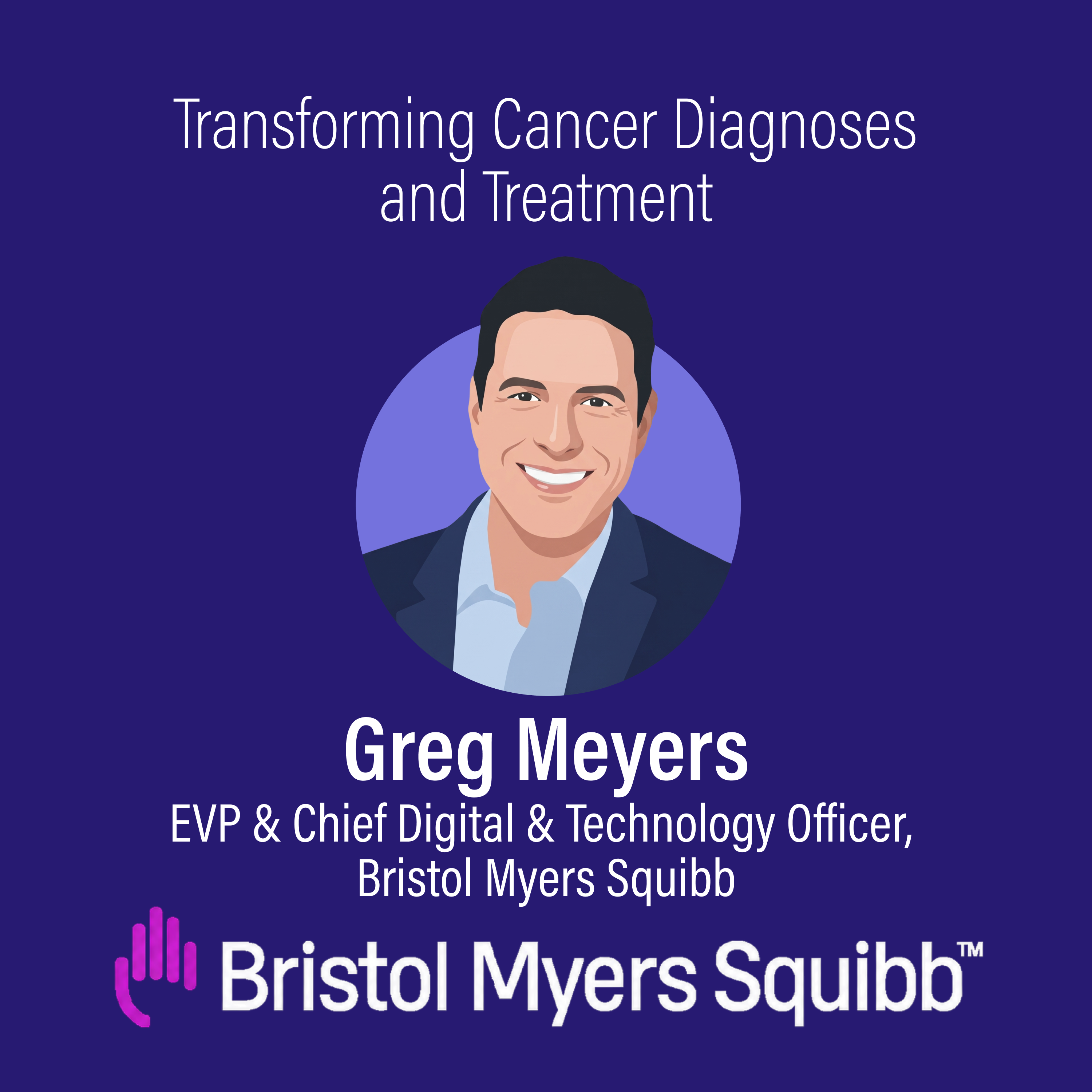
Transforming Cancer Diagnoses and Treatment
Read about Greg's perspective on how Bristol Myers Squibb is using AI to accelerate drug discovery and patient diagnosis, including an AI model that doubled new non-small cell lung cancer diagnoses across 14 clinical sites, and an internal accelerator that gives small teams twelve weeks to prove or kill an idea.
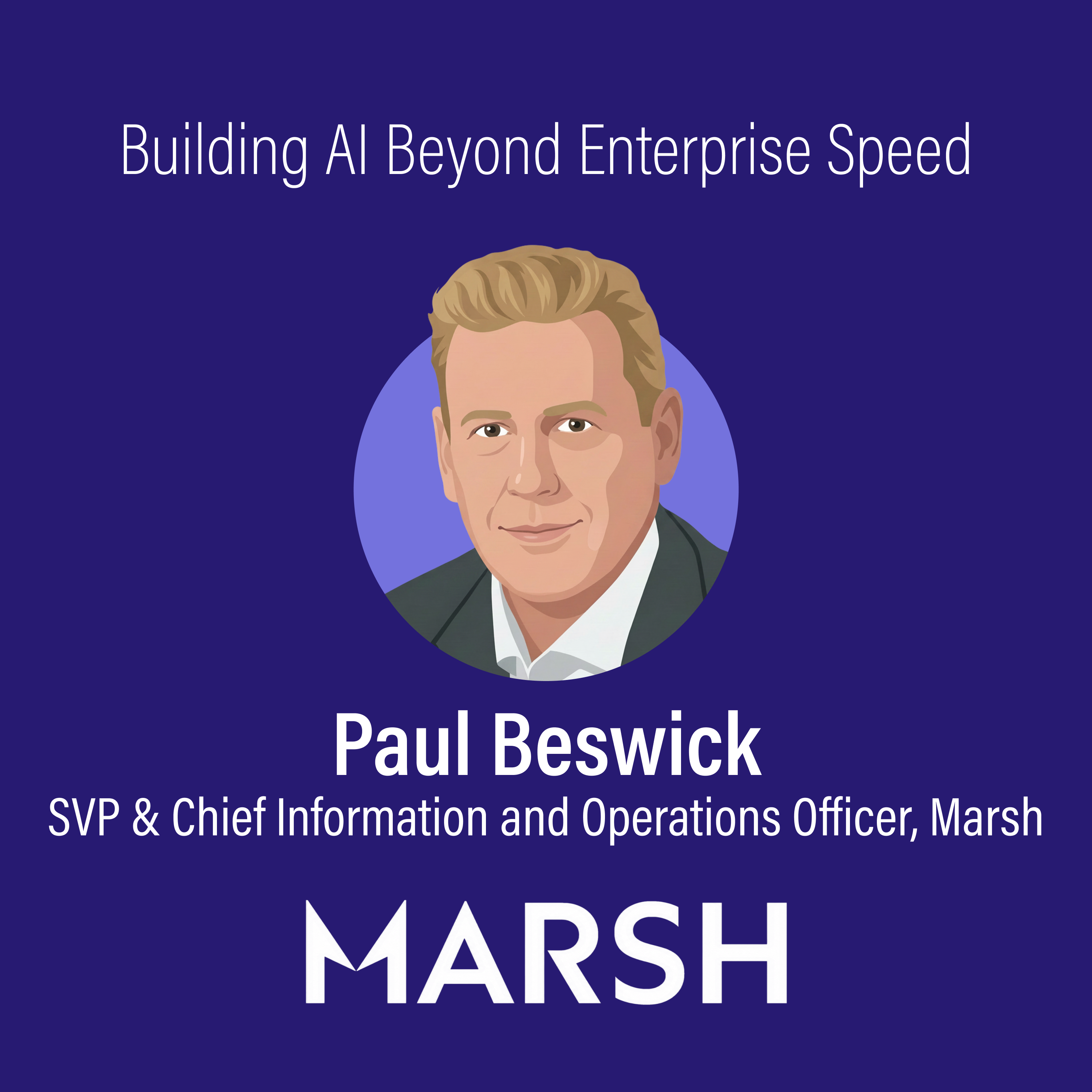
AI Beyond Enterprise Speed
Read about Paul's perspective on how Marsh is using AI to rebuild internal knowledge work and client-facing products, including a voice-based crowdsourcing pilot that turns scattered expert opinion into a scalable artifact, and a home-built productivity stack that trails the commercial market by only a few months at a fraction of the cost.